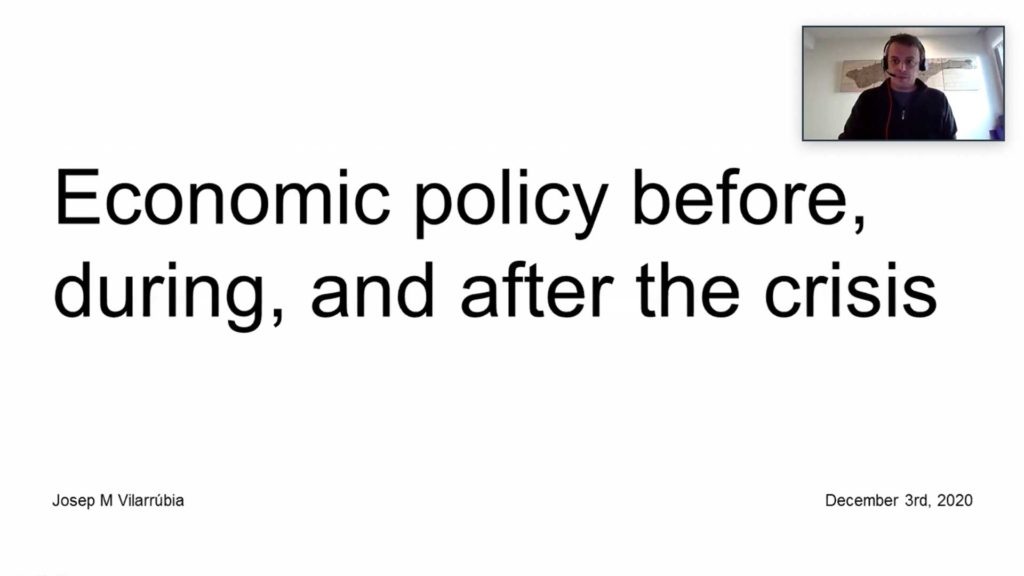
The students of Master of Science In International Business (MScIB) that follow International Economics course had the opportunity to attend the lecture of the economist Josep Vilarrúbia entitled “Economic policy before, during and after the crisis”.
At the beginning of the talk, Josep Vilarrúbia introduced himself and his academic and professional career. Vilarrúbia holds a PhD in Economics from Columbia University and worked in the International Economics Department at Banco de España, the Spanish central bank. Nowadays, he is the Director of Strategic and Quantitative Studies in Banc Sabadell.
The lecture of Josep Vilarrúbia pointed out the importance of the historical perspective to understand how economics has the power to change the world and hence analyze the current situation and future policies.
Vilarrúbia summarized the economic policy’s history in the Western world from World War II to our present and highlighted four significant crises that shaped us and the economy. The four crises Vilarrúbia explained were: the oil crises in the 1970s, the Great Recession and financial crisis in 2008, the crack of liberal order since 2016 and, the latest one, the COVID-19 crisis we are still facing.
From all these crises and its different responses, history makes clear that austerity and cutting the government spending did not work as expected and, as a matter of fact, it was a very harmful policy because it increased social inequality.
Vilarrúbia said that economic, monetary and regulatory policies applied during the Great Recession crisis are somehow responsible for the ascent of populism and economic nationalism and the decline of multilateralism, among other things. However, the economist also mentioned that although the COVID-19 is a highly complex, asymmetric and deep crisis, the policy response has been very different from the historical ones.
The pandemic has shown up some underlying trends in the global economy (deglobalization, lack of global governance, etc.) or the institutional framework (growing role of the State, reduced independence of central banks, etc.) and the acceleration of digital transformation and social inequality. But, so far, the response to COVID-19 crisis has been a highly coordinated expansive fiscal and monetary policy. Vilarrúbia said that some economists think COVID-19 recovery will not look like an L, U, V or W but a K: a new letter shape. This K recovery would mean excellent perspectives for some people but, at the same time, terrible for others.
In the end, Vilarrúbia wanted to break the pessimistic projections by telling the students that there is also some hope in the future of economic policies. The economist mentioned the Environmental, Social and Corporate Governance (ESG) commitment policies, the rise of multilateralism initiatives such as NextGeneration EU or the challenge to empower civil society communities.

Leave a message