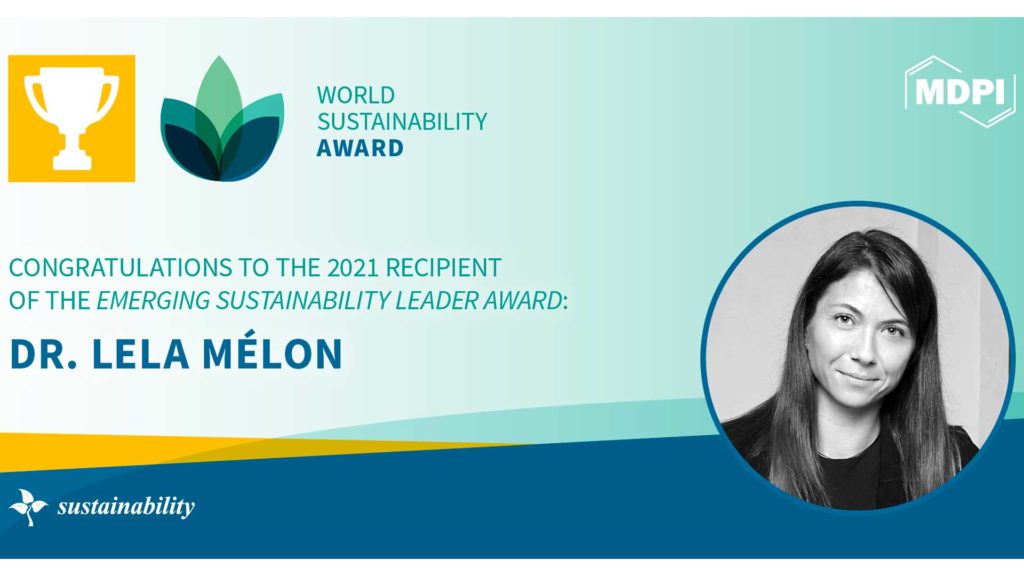
Lela Mélon Wins the Emerging Sustainability Leader Award
14/09/2021
1 min reading time
Photo: World Sustainability Forum (MDPI)
Lela Mélon, ESCI-UPF lecturer and Executive Director of Planetary Wellbeing project, has been recognized with the 2021 Emerging Sustainability Leader Award, organized and funded by the MDPI journal Sustainability. The Emerging Sustainability Leader Award recognizes individual researchers aged 40 or under that have made a significant academic or societal contribution to sustainability.
Nominations for the prize are taken from the entire international research community. This year, the award has been shared ex aequo with Dr Anet Režek Jambrak, professor at the Faculty of Food Technology and Biotechnology of the University of Zagreb. Both lecturers will share equally the prize sum, 20,000 USD.
The award ceremony was held online yesterday during the 9th World Sustainability Forum, where Dr Mélon participated with a brief presentation about her work within the sustainability research field.
The selection committee has assessed Lela Mélon academic contribution to sustainability and her remarkable impact in changing the paradigm in corporate law –connecting the private and the public sector and opening science to broader society. The committee has also valued Mélon’s personal and professional passion and dedication to furthering sustainability in the corporate sector and in the field of higher education.
The ESCI-UPF community is glad to share this announcement and congratulates professor Lela Mélon on the award.
The UNESCO Chair in Life Cycle and Climate Change at ESCI-UPF participated in the 6th SEE SDEWES Conference, held in Burgas, Bulgaria, from 28 June to 1 July 2026, which brought together 102 participants from 30 countries and featured 158 scientific contributions addressing some of the most pressing challenges in sustainable development.
The Master of Science in Sustainability Management, jointly offered by ESCI-UPF and UPF-BSM, welcomes 32 new students from 19 countries. The academic year began with a collaborative challenge addressing sustainable packaging solutions for the hospitality industry.
Un recent estudi revela que distribuir la medicació ambulatòria de dispensació hospitalària a través de les farmàcies comunitàries redueix gairebé el 50% en les emissions de CO₂, un dels principals gasos d’efecte d’hivernacle, que produeixen els pacients en els seus desplaçaments per recollir-la.



Leave a message