Ilija Sazdovski, researcher at UNESCO Chair in Life Cycle and Climate Change, has attended the Energy Community Summer School 2021, hosted by the University of Vienna.
The Energy Community Summer School is a postgraduate training program in energy-related topics, allowing students to gain sound knowledge and understanding of development of energy policy and regulation of the energy sector. The School was established in 2016 and at this point is probably the best multi-disciplinary energy-related summer school in Europe.
It welcomed 45 most talented postgraduate students and young professionals coming from academia, public administration, research centres and NGO’s from 23 countries. The approach of the school is a multi-disciplinary one, ranging from science to governance. The Energy Community Summer School is covering scientific, legal, economic, cultural, political as well as technical aspects of the energy production, supply and consumption of energy. This holistic approach is allowing the students to become aware of the complexity of topical energy issues from different points of view, while at the same time enabling them to find new approaches and come to solutions so urgently needed in Europe.
My lecture was titled “Evaluating sustainability. Prospects of Successful Energy Planning” and offered a unique possibility to the young experts from various disciplines to discuss different aspects of energy planning, taking into consideration social, environmental and economic aspects based on multi-criteria analysis.
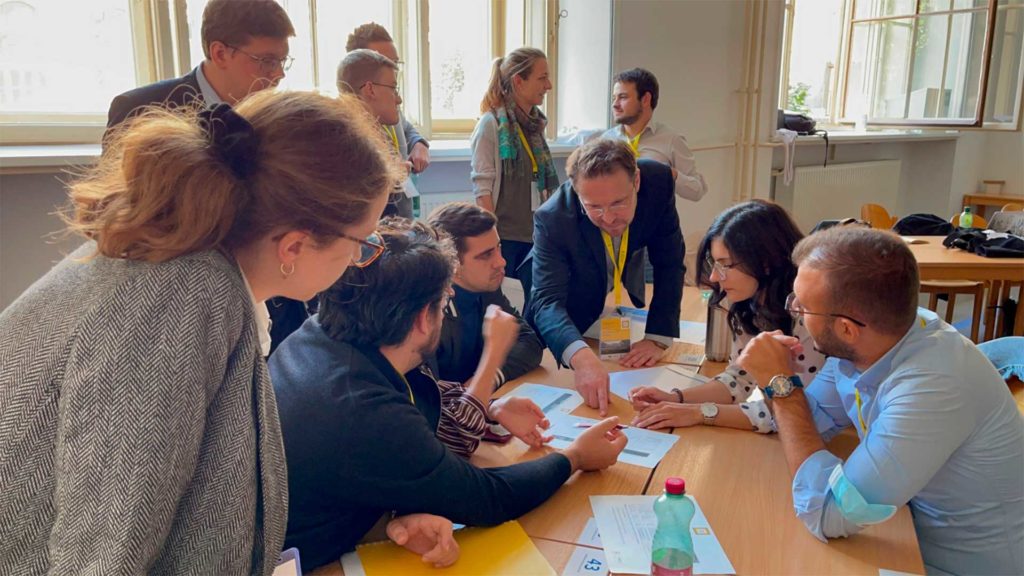
During the session the students were divided into groups where they actively participated in the discussions, debating about various points of view based on their assigned roles. The main aim of the exercise was to provide the students with the basic knowledge about sustainability evaluation of energy planning measures against a set of pre-defined evaluation criteria.
Sharing the speaking floor with more than 35 high-level representatives from the European Commission and Energy Community, International Financing Institutions, distinguished professors from the academic sector and practitioners from the private sector was a real privilege. Also, speaking at a University that affiliated 21 Nobel Prize laureates in the past was a real honour.
From June 4 to 5, Sandra Ceballos-Santos, researcher at the UNESCO Chair in Life Cycle and Climate Change (ESCI-UPF), participated in the World Symposium on Sustainability Governance (WSSG), held at the University of Salamanca.
From May 17 to 21, Sandra Ceballos-Santos, researcher at the UNESCO Chair in Life Cycle and Climate Change (ESCI-UPF), participated in the SETAC Europe 36th Annual Meeting held in Maastricht, The Netherlands.
A new study led by the UNESCO Chair in Life Cycle and Climate Change at ESCI-UPF analyses how biofertilizers, biostimulants, organic amendments, and intercropping systems can reduce the environmental impact of agriculture while maintaining crop productivity in Denmark and Ukraine.



Leave a message